What Is Card Grading? Reading the 1-10 Scale

What is card grading?
Card grading means handing your card to an independent third party who inspects it and assigns a condition score on a fixed 1–10 scale. That grade — together with the card's identity and a unique serial — is recorded so anyone can trust it later. It turns a subjective "looks mint to me" into a documented, verifiable verdict.
Once a card is graded, that verdict travels with it: buyers can look up the serial, sellers can price with confidence, and the card's condition stops being a matter of opinion. For collectible trading cards — Pokémon, other TCGs, and sports cards — a grade does three big jobs at once.
Why grading matters
- Value. Condition drives price. The same card in a 9 versus a 10 can be worth wildly different amounts, and a trusted grade is what lets a buyer pay confidently for the better copy.
- Liquidity. A graded card is easier to sell. Buyers don't have to guess about tiny scratches or off-centering — the grade already answers those questions, so cards move faster.
- Authenticity confidence. Grading confirms a card is genuine, which matters more every year as fakes get better. A serial anyone can look up beats a photo you just have to trust.
Reading the 1–10 scale
Higher is better. Here's roughly what each band means:
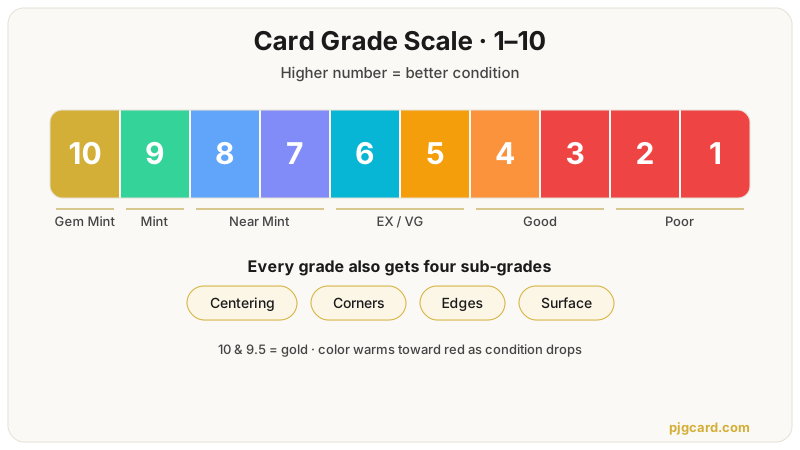
- 10 (Gem Mint) & 9.5 — virtually flawless: sharp corners, clean surface, near-perfect centering.
- 9 (Mint) — excellent, with only the tiniest imperfection under close inspection.
- 8–7 (Near Mint) — very nice; minor wear such as a soft corner or slight off-centering.
- 6–5 (Excellent / Very Good) — clearly handled but presentable; visible edge or surface wear.
- 4–3 (Good) — heavier wear, creasing, or scuffing.
- ≤2 (Poor) — significant damage.
On the PJG scale the colors track quality: 10 and 9.5 are gold, 9 emerald, 8 blue, then the tones warm through to red at the low end — so you can read a grade at a glance.
The four sub-grades
A single overall number hides detail, so graders also break condition into four sub-grades:
- Centering — how evenly the border and artwork are framed, front and back.
- Corners — sharpness versus rounding or fraying.
- Edges — cleanliness versus nicks and whitening.
- Surface — scratches, print lines, gloss, and dents.
Because a card's final grade is capped by its weakest area, one soft corner or a distracting print line can hold back an otherwise stunning card. Centering, in particular, is often the quiet deal-breaker. As a public benchmark, a PSA Gem-Mint 10 generally wants front centering around 55/45 and back around 75/25 — tighter than most people eyeball. You can measure your own before you commit with our free tool.
What PJG offers today
You don't have to jump straight to a full grade. PJG gives you a ladder:
- 🤖 AI pre-grade — $1/card. "PJG AI Vision" returns an estimated overall grade plus all four sub-grades. It's an AI estimate to guide your decision, not an official grade.
- 🛡️ Guarantee — $4. An authenticity and condition check with a clear verdict (serial starts with "GU"). Great when "is this real?" matters most.
- 🔍 Pre-Grade — $7. A full expert grade in a protective top-loader (serial starts with "PG"), without a sealed slab.
A sealed PJG slab is coming soon. Alongside all of this you get free tools with no login required: measure centering, a should-I-grade calculator, and a real-vs-fake guide.
Start here
Curious what your card would score? Run a quick AI pre-grade or send it in, check the math with the ROI tool, or measure centering yourself first.