Centering, Explained: The Sub-Grade That Caps Your Grade
Every graded card gets one number on the label, but that number is built from four sub-grades: centering, corners, edges, and surface. Centering is the one collectors underestimate the most — and it is often the reason a mint-looking card comes back a point (or two) lower than expected. Here is exactly what it is, how it is measured, and how to check it yourself for free before you pay to grade.
What centering actually is
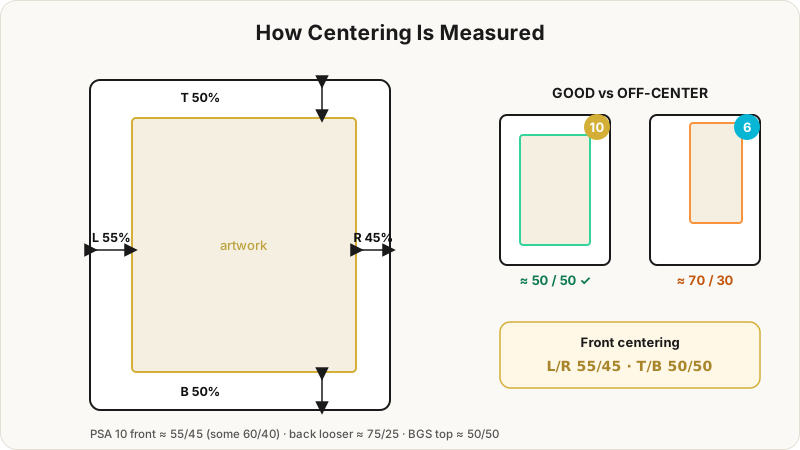
Centering describes how evenly the card's design sits inside its borders. A perfectly centered card has equal borders on the left and right, and equal borders on the top and bottom. The image does not need to be dead-center to look nice — but graders measure it precisely, because the eye forgives what the ruler does not.
How it is measured
Graders compare opposite borders as a ratio, not as absolute millimeters. They look at two axes:
- Left-to-right: the width of the left border versus the right border
- Top-to-bottom: the top border versus the bottom border
Add the two opposite borders together, then express each as a percentage of that total. If the left border takes up 55% of the combined left-plus-right width and the right takes 45%, the horizontal centering is 55/45. Do the same top-to-bottom. The worse of the two axes is what tends to hold your grade back.
Thresholds by grade
Different companies draw the line in different places, but the pattern is consistent — the top grade demands near-perfect centering, and the standards loosen as grades drop. As a rough guide from public grading standards:
- Front centering for a Gem-Mint 10: about 55/45, with some standards allowing up to 60/40
- Back centering: looser — often around 75/25 is still acceptable for the top grade
- BGS top tier: roughly 50/50 to 55/45 on the front
As you move down to 9, 8, and below, the allowable off-centering widens step by step.
How centering caps your final grade
Here is the part that surprises people: a final grade usually cannot rise far above its weakest sub-grade. A card with flawless corners, edges, and surface but 70/30 centering will not receive a 10 — the centering pulls the ceiling down. That is why centering is worth checking before you spend money on grading. If the centering caps you at, say, a 7 or 8, you can price and sell accordingly instead of paying for a 10 you were never going to get.
Check yours for free
You do not need special equipment to get a reliable read. Our free Centering Tool lets you upload or snap a photo, mark the borders, and get an instant left/right and top/bottom ratio — with homography angle-correction, so the measurement stays accurate even if your photo is shot at a slight angle. No login, no cost.
Once you know your centering, the ROI tool can help you decide whether grading is worth it at all — and if it is, you can start with a PJG AI pre-grade ($1) for a quick four-sub-grade estimate before committing.