Is Your Card Worth Grading? Do the Math First
Should you grade that card? Do the math first
Grading adds cost and time, so the honest first question isn't "how do I grade this?" — it's "is grading worth it for this card?" The answer is almost always a math problem, and it comes down to whether the value a grade unlocks is bigger than the fee you pay to get it.
The simple rule
Grade a card when three things line up:
- The raw card already has real value. Fees are roughly fixed, so they eat a huge share of a cheap card and a tiny share of an expensive one.
- The condition looks strong. The uplift from grading comes from high grades. A card likely to land a 9 or 10 gains a lot; a card headed for a 5 usually doesn't.
- The card is popular. Sought-after sets and characters have deep buyer demand, so a strong grade actually converts into a higher sale.
If a card fails all three — low value, rough condition, thin demand — grading usually costs more than it returns, and you're better off selling it raw or keeping it in the binder. The sweet spot is a desirable card that already looks clean to the naked eye.
A worked example
Let's use round, hypothetical numbers to show the shape of the decision (your real prices will differ):
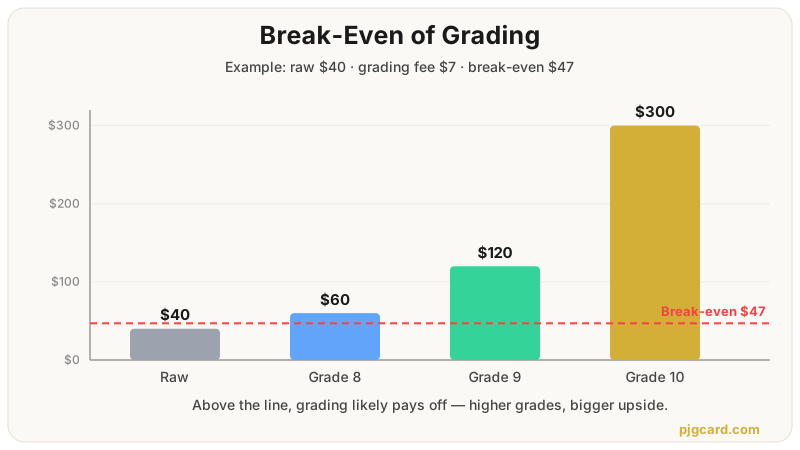
Say a raw card is worth $40, and a PJG Pre-Grade costs $7. Your break-even is simply:
- Break-even = raw value + grading fee = $40 + $7 = $47.
Now estimate the graded value at each outcome:
- Grade 8: sells for about $60 — a small win over break-even.
- Grade 9: sells for about $120 — a clear win.
- Grade 10: sells for about $300 — a big win.
The lesson: the decision hinges on the grade you're likely to get. If you're fairly sure of a 9 or higher, the math is easy. If the card might only reach a 7 or 8, the upside shrinks fast — and if a poor grade would sell for less than break-even, you'd have been better off leaving it raw.
Factor in probability
Real life isn't a single outcome — it's a spread. A smarter estimate weights each grade by how likely it is. If you think a card has a 50% shot at a 9, 30% at a 10, and 20% at an 8, your expected value blends all three. When that blended value comfortably clears your break-even, grading makes sense. When it's a coin-flip against the fee, it usually doesn't.
This is exactly what our free calculator does for you — enter the numbers and it weighs the outcomes automatically, so there's no guessing on the back of a napkin.
Lower the risk before you pay
You can shrink the uncertainty for very little:
- Run an AI pre-grade for $1. "PJG Card Vision" returns an estimated overall grade plus centering, corners, edges, and surface — a cheap read on whether a full grade is worth it.
- Measure centering yourself for free. Centering is a common grade-capper; our tool corrects for camera angle so the numbers are honest.
- Check demand. Look at what graded copies of the same card actually sell for before you commit — recent sales tell you whether the uplift is real or wishful.
Do the math, then decide
The tools do the heavy lifting: start with the ROI calculator to see your break-even and expected value, sanity-check condition with a $1 AI pre-grade, and when the numbers say go, send your card in.