How to Spot a Fake Card (Before You Buy)

Wherever a hobby gets valuable, counterfeits follow close behind. Popular Pokémon, sports, and TCG cards trade for real money today, and modern printers make convincing copies cheap to produce. The good news: most fakes fall apart under a few minutes of careful inspection. You just need to know where to look — and to do it before the money changes hands.
Five quick tells anyone can check
1. Surface texture and finish
Genuine cards have a consistent, purpose-made finish — a subtle linen texture on many Pokémon cards, or a specific gloss on chrome and prizm sports cards. Fakes often feel too slick, too matte, or weirdly sticky. Tilt the card under light: the coating should look even, with no cloudy patches or orange-peel bumps.
2. Color and the print-dot pattern
This is the single most reliable tell. Genuine cards are printed with a CMYK rosette — tiny cyan, magenta, yellow, and black dots arranged in a flower-like pattern you can see under a loupe. Many fakes are laser or inkjet copies, which show solid lines, a coarse grid, or fuzzy pixels instead of clean rosettes. While you are there, check the colors themselves: fakes often run too dark, too saturated, or slightly off-hue.
3. Edges and cut
Look at the card edge straight-on and in cross-section. Authentic cards have a clean cut and, on many modern cards, a distinct core color between the layers. Fakes can show rough, fraying, or lightly peeling edges, uneven cuts, or a core that is the wrong color — or missing entirely.
4. Weight and thickness
Manufacturers are consistent. A cheap scale that reads to 0.01 g plus a set of calipers will catch a surprising number of fakes — they are frequently off by a few hundredths of a gram, or noticeably thinner or thicker than a known-genuine copy of the same card. Always compare against a card you trust.
5. Holo and light behavior
Holographic and foil patterns are hard to fake well. Rotate the card slowly under a single light source: genuine holo has a specific sparkle pattern and direction. Fakes often look flat, rainbow-smeared, printed-on, or reflect light in the wrong way.
A simple toolkit (about $40)
- Jeweler's loupe, 30x–60x (~$10–15) — for the print dots and edges
- A bright, single LED light or phone torch (free) — for surface and holo
- Digital scale to 0.01 g (~$12–20) — for weight
- Calipers (optional, ~$10) — for thickness
That kit costs roughly the same as one graded common — and pays for itself the first time it stops a bad buy.
Real vs fake, up close
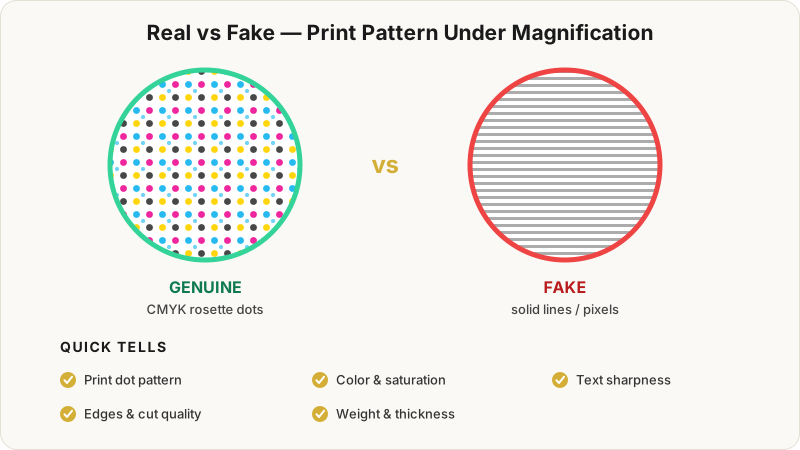
Under magnification the difference is obvious: genuine printing shows the rosette of separate CMYK dots, while a reprint shows lines or pixels. If you only learn one tell, learn this one.
When to let an expert decide
Some counterfeits are genuinely good, and high-value cards deserve a second opinion. If you are unsure, PJG Guarantee ($4) gives you a professional authenticity and condition verdict — is it real, and what shape is it in. It is a verdict, not a numeric grade (the serial starts with GU), and it is the fast, affordable way to buy or sell with confidence. Start one from our submit page.
Go deeper
Want the full playbook? Our free Card Guide covers real-vs-fake tells for 13 different card types, plus how the major grading standards compare — no login required.